
Searching Cass County Criminal Dockets
Start with Indiana Odyssey Public Access, or MyCase. It is the free route to a public Chronological Case Summary, called a CCS. If you know the case number, search on it. Otherwise use a last name and narrow the results by Cass court, case type, status, and filing date. MyCase covers public, nonconfidential information only, and the screen itself is not the official record.
- Choose the Case, Name, or Attorney tab.
- Enter one identifier or a last name.
- Select a Cass court, or all courts if unsure.
- Open the matching result and read the full CCS.
- Ask the Clerk for a certified or missing record.
When a broad name search floods you with hits, tighten the terms rather than harvesting every result. Case numbers are forgiving to a point: hyphens and leading zeros can drop out. Still, the exact number is the safest search.
Cass Criminal Access Channels
The internet is only one route. Destry Richey is the Cass County Clerk. She keeps the records for Circuit and Superior Courts I and II. Her counter sits in Room 407 at 200 Court Park, Logansport. It is open weekdays from 8:00 a.m. to 4:00 p.m. Call (574) 753-7740 for certified copies, older paper files, current balances, and documents not linked online. The office lists no general court-copy email, dropbox, or fax-request process. So confirm a method before sending anything.
For a current setting, call the assigned court. Circuit is at (574) 753-7730. Superior I is at (574) 753-7735, and Superior II is at (574) 735-6841. Transcripts run through the court reporter. E-filing serves authorized filers and is no public lookup.
Inside a Cass County Criminal Docket
A CCS is a dated list of events. Expect filing and case type, public charge labels, appearances, attorneys, motions, orders, plea or trial settings, disposition, sentence, probation events, financial entries, and linked public documents. Not every event carries a viewable image, though.
| Case number | Cass prefixes include 09C01, 09D01, and 09D02. |
|---|---|
| CCS event | A date plus filing, appearance, order, notice, or other action. |
| Setting | Hearing type, date, time, judge, or room when public. |
| Outcome | Disposition, judgment, sentence, and later events. |
Read the chronology as one story. Dismissed, deferred, closed, and guilty plea mark different entries, so treat them as distinct outcomes rather than synonyms.
Cass CCS Versus Arrest Data
A Cass County criminal docket answers what happened in a court case, nothing more. It is not a jail roster, police incident report, arrest log, or criminal-history product. Those sources live with other offices. A CCS can name a filed charge and its court result. It does not hold the facts a police report would. Ask the Clerk for a court filing. Ask the court reporter for a transcript. Do not ask another county agency to certify the court record.
How a Criminal Case Moves
Most cases open with a filing and an initial appearance or arraignment. Pretrial settings, motions, notices, and orders follow as needed. A plea, trial, dismissal, or other disposition may then resolve the case. Sentencing and probation entries appear where applicable. A continuance simply creates a later CCS event; the old date stays on the record.
Docket flow: Filing › Arraignment › Pretrial › Plea or Trial › Disposition › Sentencing
No case uses every step. For the current stage, trust the newest CCS entry and the assigned court.
Cass Criminal Filing Mix
Official ICOR data offers scale, not a result about any person. Its 2024 all-Cass response showed 2,352 new criminal matters, including 1,054 misdemeanors, 832 miscellaneous criminal matters, and 345 Level 6 felonies. Superior II carried most listed misdemeanor activity. Superior I carried most Level 6 activity.
These figures are filing or activity categories, not convictions, people, or open-case counts. They also explain why court and type filters sharpen a broad docket search.
Courts That Hold Criminal Dockets
The Cass allocation plan routes Level 6 felonies to Superior I, while misdemeanors and infractions go to Superior II. Other felonies land by random assignment between Circuit and Superior II. Related or multi-defendant matters may follow the highest charge. A transfer can also change the assigned court at any point.
| Court | Starting allocation | Code |
|---|---|---|
| Circuit | Share of higher felonies | 09C01 |
| Superior I | Level 6 felonies | 09D01 |
| Superior II | Misdemeanors, infractions, other felonies | 09D02 |
Use the latest CCS assignment, not the expected allocation alone.
Cass Transfers Change Searches
Local rules permit a transfer when the receiving court has jurisdiction and accepts the matter. The Record of Judgments and Orders may carry the entry. If the expected court yields no hit, search all three Cass courts. You can also use the exact cause number. A separate rule sends a felony or misdemeanor refiled within six months of dismissal back to the judge from whom dismissal was taken. Distinguish earlier entries from later ones rather than merging them into a single outcome.
A transfer is also why court prefixes work as locators, not permanent labels. Keep the whole cause number when calling the Clerk. Ask which court now holds the file. Ask whether the event sits in the CCS or the RJO. Ask whether a linked document is public. That check beats repeating a name search in one court.
Sealed Dockets and Public Access
Indiana presumes public access to court records. But remote access can be narrower than what you read at the courthouse. Juvenile material, expunged matters, and protected data may be hidden. Records excluded by law, rule, or order can be hidden in whole or in part. A visible case can still hold a blocked document. And an empty search result is never proof that no file exists.
Key rules:
Access Rule 4 states the access presumption.
Access Rule 5 lists excluded categories.
Access Rule 9 provides a verified extraordinary-access process.
Criminal Rule 1.2 applies the access rules to criminal records.
Ask the Clerk about a public copy or an access status. Rule 9 is a formal request, not a casual email.
Cass Criminal Source Screens
The uniform case-number rule shown below explains the court prefix.
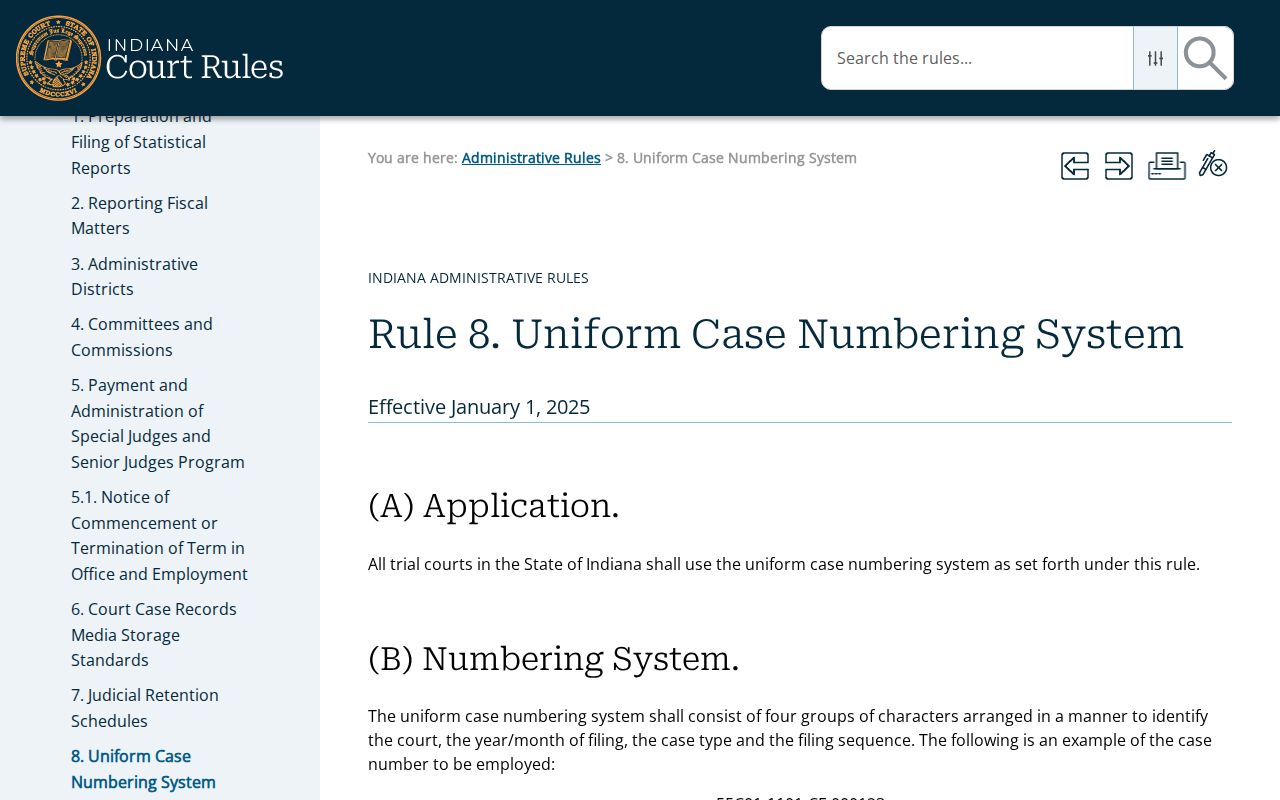
The live CCS shows the full cause number, and the criminal access rule is posted on the same page.
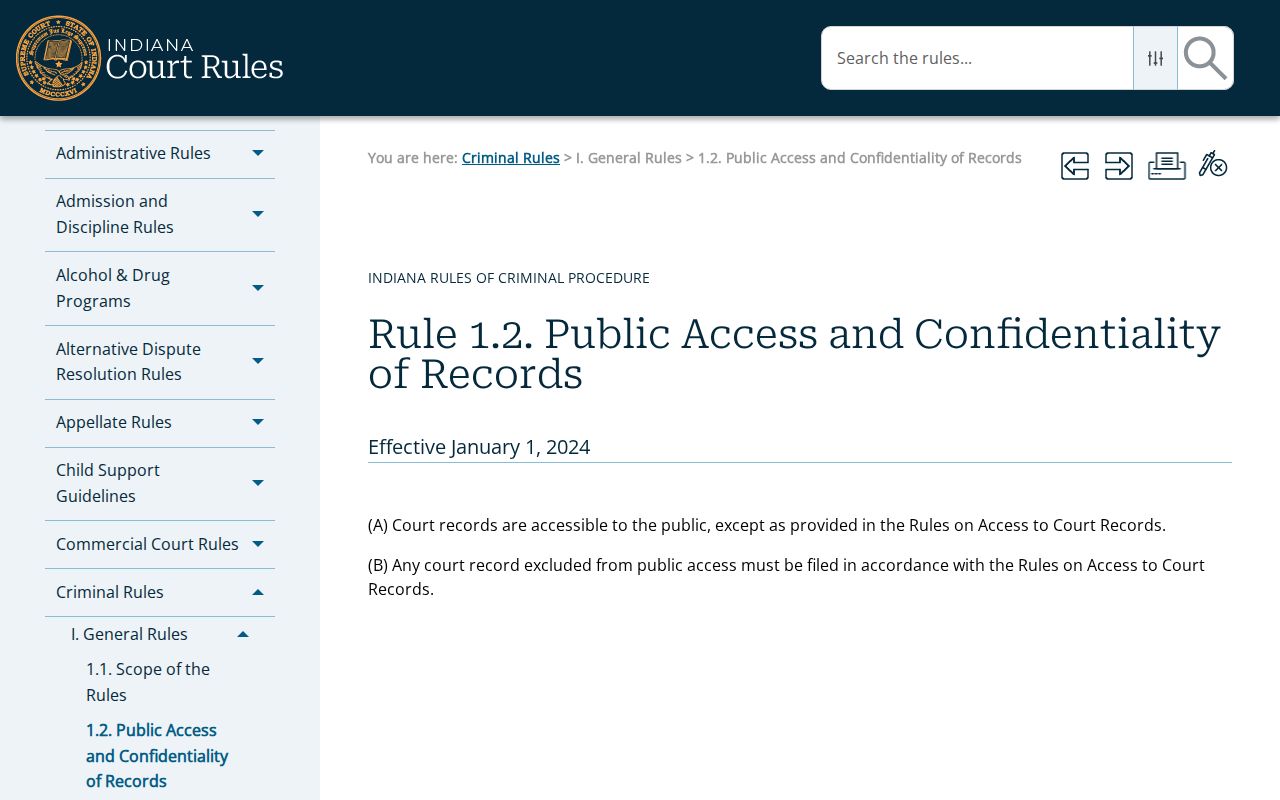
Indiana's access limits still govern public criminal records here. The Cass diversion page covers deferral and diversion.
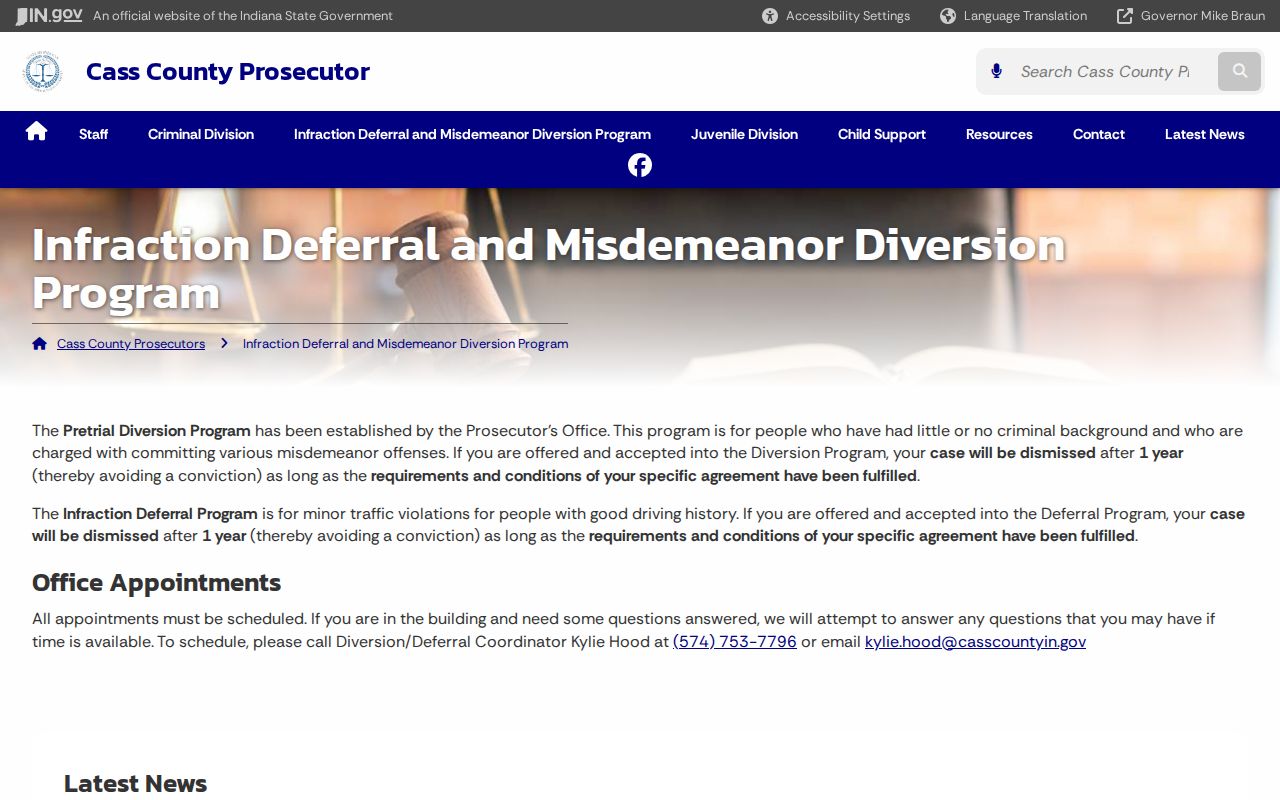
Deferral is a named program, not a generic dismissal label.
Cass Criminal Copies and Certification
A MyCase screen helps you follow a case. It is not a certified criminal court record. The official files sit with Destry Richey, Cass County Clerk, for the Circuit Court and Superior Courts I and II. Visit the counter at 200 Court Park, Room 407, in Logansport. Hours run weekdays, 8:00 a.m. to 4:00 p.m. Before ordering an older file, an unlinked order, or a certified CCS, call (574) 753-7740. Plain copies cost $0.25 per page. Certification adds $3 plus the applicable page charge.
When you place a request, give the full cause number, the assigned court, and the event or date range you need. Say plainly whether the copy must be plain or certified. The county warns that document work is handled first-come. It may hit backlog, so build in time. The clerk lists no general email, dropbox, or fax route for court copies. Confirm delivery and payment by phone before sending anything. Want a transcript of spoken proceedings? That comes from the court reporter, not the Clerk.
Cass Criminal Outcomes Need Context
Cass posted 2024 disposition data for all of its courts. The categories cover jury and bench trials, bench dispositions, dismissals, defaults, deferred or diverted outcomes, guilty pleas or admissions, violations-bureau outcomes, and closed matters. Each label tracks a kind of reported activity. None of them tells the whole story of a case or a person. Read charge-level and case-level docket entries in order, since one outcome rarely stands alone. A dismissal can be followed by a refiled case. Cass local rules send a felony or misdemeanor refiled within six months back to the judge who dismissed it. A deferred result usually reflects a prosecutor program with set conditions. It is not a quiet erasure of the charge. For the exact legal effect, the filed order controls.